Homeowners' pick for appliance repair across the Ohio Valley
Washer Repair — Book a Visit Today
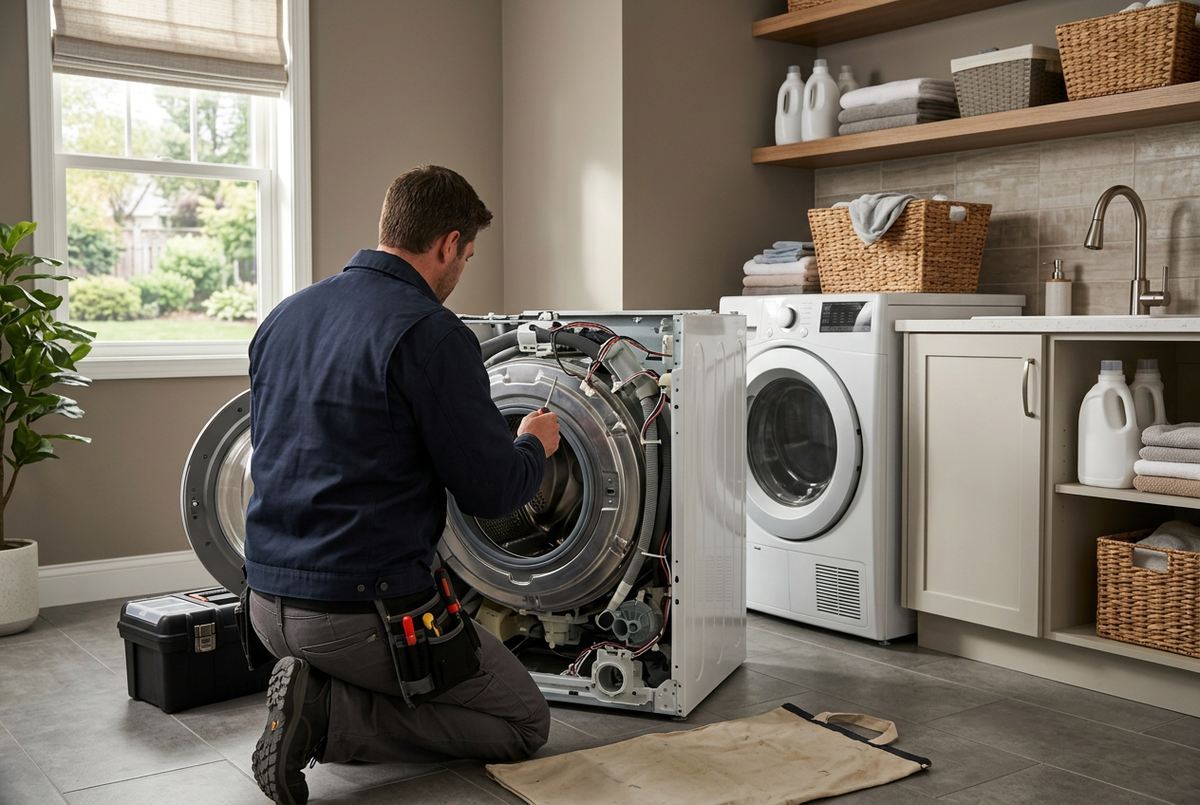
We repair top-load and front-load washers across Louisville and thirty surrounding counties, so call us and we will sort out a time. Washers work hard here. Limestone hard water scales up valves and heaters, and river-valley humidity keeps a drum smelling sour long after the load is done. Put that machine in a shotgun house laundry closet wedged behind the kitchen and a small leak can go unnoticed for weeks. What usually fails: drain pumps clogged with lint and coins, worn door boots, tired lid switches, rumbly shocks and bearings, control boards, and inlet valves choked with mineral grit. A visit starts with your description, then we run a cycle and listen at fill, drain, and spin. We pull the panel, check hoses and wiring, and tell you plainly what the machine needs. Gas room or electric, either way we come to you.
Call (800) 967-1507- You reach a person, not a menu
- Open every day
- The quote comes first, in writing
Taking calls until 5:00 PM ET
The washer symptoms we hear most
- It stops with water still in the tub Blocked drain pump, kinked drain hose, or a pump motor that quit
- Spins so hard the floor shakes Worn suspension rods or shocks, load sensing off, leveling feet backed out
- Fills forever and never starts washing Inlet valve screens fouled with mineral scale, or a bad pressure switch
- Water on the floor after every load Split door boot, loose hose clamp, or a cracked tub-to-pump hose
- Grinding and a burnt smell on spin Drum bearing going out, worn drive belt, or debris caught in the outer tub
Safe things to check first
Worth a look before you call — sometimes it saves you the visit.
- 1Unplug the washer and look underneath with a flashlight. A wet trail usually tells you which side is leaking.
- 2Make sure both fill hoses are open at the shutoffs and not crimped behind the machine.
- 3Pull the drain hose out of the standpipe and check that the hose end sits high enough that water cannot siphon back.
- 4Rock the corners of the cabinet by hand and see whether a leveling foot has backed out on an uneven floor.
What homeowners get from an independent shop
| JG Appliance Repairs | Big-box repair chains | Handyman listings | |
|---|---|---|---|
| Written quote before any work | ✓ | ✕ | ✕ |
| Live answer seven days a week | ✓ | ✕ | ✓ |
| Every major brand, gas or electric | ✓ | ✓ | ✕ |
| Independent shop, nobody's quota | ✓ | ✕ | ✓ |
| Crews familiar with homes like yours | ✓ | ✕ | ✓ |
After the visit, in their words
“No upsell talk at all. He fixed the drain pump and pointed out a hose I should watch, that was it.”
Jeff D.Springfield, IL“The scheduler actually listened to the symptoms and sent the guy with the right parts.”
Priya N.South Bend, IN“Dishwasher stopped mid-cycle full of water. They walked me through draining it on the phone before the visit even happened.”
Carl H.Portsmouth, VAWasher Repair — quick answers
Is my front-load washer worth fixing?
Often yes. Pumps, boots, hinges, and shocks are wear parts on a machine that is otherwise sound. If we find a failed bearing in a very old cabinet, we say so and let you decide. Call us and we will talk through the specifics.
Why does my washer smell sour?
Humidity plus detergent residue feeds biofilm in the boot folds, the dispenser, and the drain hose. We clean those areas, check the drain path, and show you where the moisture is sitting. Leaving the door ajar between loads helps more than most people expect.
Can hard water really break a washer?
It shortens the life of parts. Scale narrows inlet valve screens, coats heating elements, and stiffens rubber, so loads take longer and detergent works less well. We flush and replace whatever the mineral buildup has ruined, then point out what to watch.
How long does a typical washer repair take?
Many jobs finish in one visit once we see the machine. Pumps, belts, hoses, and switches are common parts we usually stock. A control board or a special-order component means a second trip, and we tell you that on day one.
Do you work on stacked laundry units?
Yes. Stacked and closet-tucked installs are common in older homes around here. We need clearance to slide the washer forward, so moving baskets and shelving out before we arrive saves real time.
Should I keep running it until you get here?
No. If it leaks, grinds, or trips a breaker, unplug it and close the water valves. Running a damaged machine can turn a small part into a bigger one. Describe the noise when you call us.
How it works
- Step 1
Tell us the symptom
Ring us or fill in the form, then describe the noise, the smell, or the puddle. Brand and rough age help too. Those small details narrow down the part before anyone drives to your door.
- Step 2
We set a window
You get a visit window that fits your day, not ours, and we text when the van is close. Older shotgun houses have tight halls. Tell us where the machine sits.
- Step 3
Diagnose and repair
Our tech tests the machine, shows you what failed, and explains the fix in plain words. Common parts ride in the van. If something has to be ordered, we schedule the return trip before we leave.
- A real person answers
- Open 7 days
- Written quote before work starts
Why homeowners call us
- Hard water is our daily workLimestone water scales heating elements and clogs dishwasher jets, and it crusts up valves until they stick. We see it every week here. So we look past the error code to the mineral buildup behind it, then tell you how to slow the next round down.
- River-valley damp changes thingsHumidity in this valley rusts dryer housings and sours washer gaskets, and it stalls condensate drains. Basement laundry rooms have it worst. We check venting and drainage on every laundry call, because a dry machine stays fixed longer.
- Independent, all major brandsWe work on refrigerators, ranges, ovens, dishwashers, washers, and dryers from every major maker. No brand pays us, and no brand tells us what to say. When we talk about repairing versus replacing, that advice is ours alone.
- Old houses, careful handsShotgun homes and pre-war kitchens come with narrow doorways, soft floors, and odd wiring. We pad thresholds and protect trim, and heavy units move slowly. When we leave, the only change in your house should be a working appliance.
- All major brands, gas & electricIndependent service on Whirlpool, LG, Samsung, GE, Maytag, Bosch, KitchenAid and the rest.
- Straight answersIf it isn't worth repairing, we'll say so, often right on the phone.
Washer Repair
Small faults become big ones on a schedule of their own
Describe the symptoms and we'll book the visit — takes about a minute.
- A real person answers
- Open 7 days
- Written quotes
- All major brands
- Gas & electric
Rather not call? Get a free quote →